Natty Shafer Law

Utah lawyer for criminal and immigration cases


Leave a comment

More on the Dubious Science of Bite Mark Analysis

A few weeks ago, I discussed some problems with bite mark analysis. It seems at least one forensic dentist agrees with me. Michael West, a Mississippi dentist, testified 81 times that bite marks on people’s bodies matched the teeth of suspects, but he no longer believes in his own specialty.

In a deposition obtained by The Clarion-Ledger, Mr. West said, “I no longer believe in bite-mark analysis. I don’t think it should be used in court. I think you should use DNA.” Previously in court he had emphasized how reliable bite mark evidence was and said that each mark was unique. Unfortunately, he was both wrong and successful at helping prosecutors get convictions. Cases he testified on are now being reviewed:

Two of those convicted in a 2001 aggravated assault case in which West testified, Leigh Stubbs and Tami Vance, are now receiving a new trial. They are both out on bond and will be arraigned today in Brookhaven.

Here’s to hoping that every state will soon prohibit this type of testimony.


1 Comment

Supreme Court to Hear Challenge on Drug Dogs

This fall, the Supreme Court of the United States will hear oral arguments in a case that challenges the use of drug-sniffing dogs to perform warrantless searches outside a suspect’s house. The case, Florida v. Jardines, arose when Miami police received a tip that Joelis Jardines was growing marijuana in his home. The police took a drug-sniffing dog around the perimeter of his house, and the dog indicated that it smelled drugs. Based on that information, the police obtained a search warrant of the house, and they found marijuana plants growing inside.

The Supreme Court has previously allowed drug-sniffing dogs to be used around cars or in the airport, but since that time a study from UC Davis has called into question the validity of drug-sniffing dogs. UC Davis recruited 18 law enforcement dogs with their human handlers for the study. Experimenters told the handlers that drugs or explosives might be present at the testing site, but neither one was present in any of the rooms. If the dogs had behaved appropriately, they would have passed through all four rooms without alerting their handlers. Only one of the 18 dogs did not falsely alert in any of the rooms.

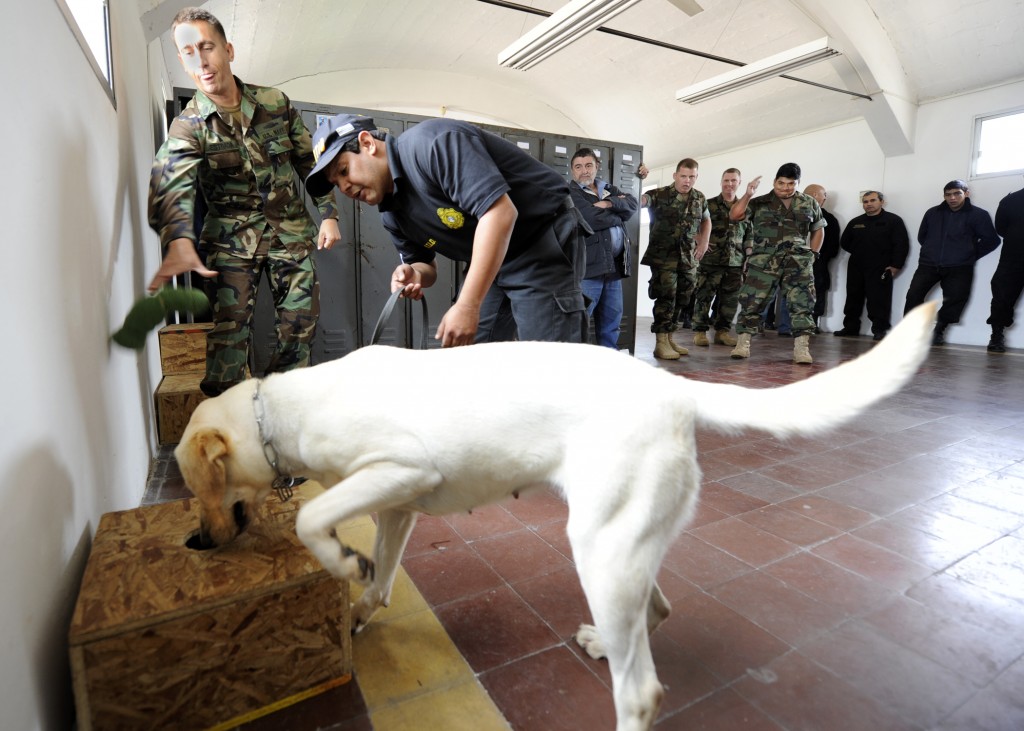
Nick Estrada of the U.S. Navy trains a drug-sniffing dog


UC Davis researchers hypothesized that the dogs were taking cues from their handlers. If that is true, the dogs are merely relaying the preconceptions of their handlers, and it calls into question the validity of drug-sniffing dogs in any circumstance.

The Supreme Court might not speak on the validity of drug-sniffing dogs when it rules on this case, but it should. It is important that police have actual evidence when they request that a search warrant from a judge; the preconceptions of dog handlers should not be enough for probable cause.


Leave a comment

Hard Science Versus Forensics, Part 5: Ballistics

Part 1: Introduction
Part 2: Fingerprints
Part 3: Bite Mark Analysis
Part 4: Arson

Photo courtesy of Niels Noordhoek

Ballistics (sometimes called “ballistic fingerprinting”) examines the markings that firearms leave on bullets to match a bullet to the firearm that fired it. Likening it to fingerprinting is an apt analogy. Like fingerprinting, ballistics suffers from a lack of independent verification of its assumptions.

Most firearms impart spin on a fired bullet, and subtle variations in the spirals within a firearm barrel leave tiny grooves called “striations” on the bullet. The striations a particular firearm imparts are supposedly unique. A technician attempts to match a bullet of unknown origin with the barrel through which the bullet was fired. However, it has not yet been proven that the striations are unique, but we know that striations are inconsistent. Different makers of bullets have different striations, even when they go through the same barrel. Wear and tear from regular use and intentional damage to the inside of the firearm barrel can also change striations.

Like fingerprinting, ballistics has to deal with the difference between lab conditions and real world conditions. Bullets fired in a laboratory are fired into a soft medium to keep the bullet intact, but bullets found at crime scenes are often damaged from smashing into hard materials. Ballistics labs do not have definitive guidelines for how much damage to a bullet is too much.

One expert may disagree with another about whether two bullets were fired from the same firearm. It is up to individual technicians to decide whether they feel comfortable that the striations on a bullet from a crime scene sufficiently match the striations from the suspected weapon. Ultimately, a human makes a judgment call, and no agency is conducting quality control to ensure the accuracy of a technician’s determination.


1 Comment

Hard Science Versus Forensics, Part 4: Arson

Read previous posts about dubious areas of forensic science by following these links:

Part 1: Introduction
Part 2: Fingerprints
Part 3: Bite Mark Analysis

Training exercise burning

Photo courtesy of 111 Emergency


Arson investigation, unfortunately, is a field where junk science has been the rule rather than the exception. Rarely are houses intentionally set on fire to allow investigators to study the unique effects of burning houses. There are subtle yet distinct differences in how houses burn in comparison to other fires. Many arson investigators rely on their intuition and have been slow to adapt to studies that show that their assumptions are bogus.

For example, it used to be that arson investigators interpreted signs that a fire burned particularly hot as proof that an accelerant, such as lighter fluid, was used. Experiments have shown that wood and gasoline fires burn at nearly identical temperatures. A natural wood fire can reach temperatures in excess of 2,000 degrees, hot enough to melt or burn many household objects. Melted copper wiring, melted steel bedsprings, and “crazed glass” all were used as evidence of arson. But crazed glass is usually the result of rapid cooling—such as when firefighters put out a blaze—and the upper ranges of pure wood fires are enough to melt copper and steel.

Another common misconception is that floors won’t burn unless an accelerant has been used. One experiment was all it took to disprove that theory. Investigators in Duval County, Florida were trying to prove that a fire could not have happened the way a defendant claimed it did. In the process, they proved his case. They spent $20,000 to hire experts and equip a condemned house with heat and gas sensors. They lit a couch on fire, without using any accelerants, and watched what happened. The fire quickly consumed the couch and filled the room with smoke. Just four and a half minutes later the room suddenly burst into flames, including the floors, walls, and furniture. The prosecutor quickly dropped the case against the defendant.

The experimental house burned so rapidly because of “flashover.” Flashover occurs when smoke and gas in a room build, to the point where it finally explodes in flames, including the floor. The house reached over 1,000 degrees just before flashover. Before this experiment, investigators were aware of flashover, but most believed it took longer to occur, especially without a liquid accelerant. It is impossible to say how much more the field of arson investigation would advance with a few more experiments.

It is still remarkably easy to be certified as an arson investigator in many states. Some states require as little as 40 hours of training before someone can be deemed an expert in arson investigation. All over the country, there are poorly trained investigators that are still using techniques that have no basis in science.


Leave a comment

Mandatory Life Terms Unconstitutional

A judge must consider youth and the nature of the crime when they sentence juveniles to prison, the United States Supreme Court ruled yesterday in Miller v. Alabama. The case involved two young juveniles who were sentenced to life in prison without parole in their respective states, Arkansas and Alabama. Each of the men were 14 when they took part in unrelated homicides. Both states imposes life in prison without parole as a mandatory sentence, which the Court said violates the Eighth Amendment’s prohibition against cruel and unusual punishment.

The decision will not necessarily free either of the men, Kuntrell Jackson of Arkansas and Evan Miller of Alabama. Nor does it prevent judges in the future from imposing life without parole on juveniles. However, it does require judges to at least consider the age of the offender, any mitigating circumstances, as well as the nature of the crimes.

This is a small, but positive step in the realm of criminal justice. Mandatory sentencing schemes are bad for society and bad for the accused. Judges should always be able to consider the circumstances of a crime before imposing sentences. Mandatory sentences are more about revenge than about crime prevention or reform. Not allowing a judge to consider circumstances in not only unjust, it’s silly.


3 Comments

Science and Forensics, Part 3: Bite Mark Analysis

Part 1: Introduction
Part 2: Fingerprints

Bite mark analysis is an area of “science” that is unique to crime investigation. Forensic dentists are usually self-employed and have no oversight. There are no rules or regulations governing the industry, and no government entity has ever reviewed the validity of bite mark evidence.

From the start, bite mark analysis has been a dubious science. As the Chicago Tribune outlined, the field was born in 1970 when eight dentists sought to seek recognition from the American Academy of Forensic Sciences as a legitimate way to identify criminals, but they needed 10 members. They scoured the meeting rooms and were able to find 2 other pathologists who also happened to hold dental degrees.

The field hasn’t improved much since then. 42 years later and forensic dentists still disagree about whether or not a particular mark is even a bite. Thanks to DNA testing, we now know that innocent people have been convicted in cases where the primary evidence was bogus bite mark analysis.

A bite leaves an imperfect impression on the skin, and irregularities in bodies cause distortions. Furthermore, teeth, unlike DNA or fingerprints, are impermanent. Even a study conducted by the American Board of Forensic Odontology found a 63.5% rate of false identifications, and yet courts continue to accept bite mark analysis into evidence.


3 Comments

Science and Forensics, Part 2: Fingerprints

Part 1: Introduction

Tented arch patterned fingerprint Everyone “knows” that each person has a unique set of fingerprints. Fingerprinting is so ingrained in our beliefs about criminal investigation that people take it for granted that fingerprints can reliably identify a suspect. Over a century of murder mysteries in novels and—more recently—television and movies have trained us to believe that fingerprinting identifies people effectively. Mark Twain wrote about fingerprints as far back as 1894 in his novel Pudd’nhead Wilson; the main character solves a murder with his eccentric fascination with the then obscure field. Since then, countless stories have turned on the information contained in a fingerprint.

Unfortunately, the most underlying premise of fingerprinting is unproven. We don’t actually know that everyone has unique fingerprints. In fact, many of our assumptions about fingerprints are unproven and haven’t been subjected to rigorous scientific analysis. We don’t know the likelihood of misidentification. We don’t have standardized rules for how much a latent print found at a crime scene needs to resemble a rolled fingerprint on file before it is certified as a “match.” We don’t even have a national accreditation body that certifies someone as an expert in fingerprints. That makes fingerprint identification the most shocking category of dubious forensic science.

The science of fingerprinting has not advanced much since the days of Francis Galton. Galton wrote the seminal book Finger Prints and published it in 1892. He was the first person to show that a person’s fingerprints do not change during a lifetime, and he invented a taxonomy for classifying fingerprints. He was also the first to postulate that each person’s fingerprints are unique. To arrive at that conclusion, he relied on a mathematical estimation that two people would have the exact same shapes at various points within his taxonomy. He concluded that the chances for duplication were 1 in 64 billion. (In 1892, that probably seemed definitively unique, but now that there are more than 7 billion people in the world, it seems less so.) Others have reconfirmed Galton’s mathematics, but over the last 130 years, there haven’t been any thorough, independent studies to verify his hypothesis.

Even if we assume that fingerprints are indeed unique, the biggest problem with the science of fingerprints is that there aren’t uniform standards for investigators. For most jurisdictions, it is up to individual examiners to decide whether they feel comfortable that a latent print from a crime scene sufficiently “matches” a suspect’s fingerprints on file. When the police or another entity rolls someone’s fingerprints, they make sure they get every finger, in pristine condition. Latent prints are almost always incomplete, smudged, and damaged. The average latent fingerprint has only about 20 percent of the full fingertip. Experts sometimes disagree about which finger a latent print came from.

Contrary to popular media, computers do not really match a latent print to a print in a database nor is it done in seconds. Instead, IAFIS, the FBI database, recognizes patterns and narrows down the potential matches from the fingerprints on file, and it takes about an hour to complete. Ultimately, a human makes a judgment call of whether a fingerprint matches, and the opinion is more art than science. No one tests these experts to see if the conclusions they draw are consistently accurate.

Perhaps the most famous instance of a wrong identification is that of Brandon Mayfield, an attorney from Oregon who the FBI erroneously thought was connected to the Madrid subway bombings. The FBI experts said that a latent fingerprint on a plastic bag containing a detonating device was “100% verified” to be Mayfield’s, despite the fact he had never been in Spain. Fortunately for Mayfield, the Spanish authorities disagreed with the FBI’s fingerprint experts. In the aftermath of the Mayfield incident, the FBI changed the way it trains its experts to testify in court. They are no longer instructed to use the same degree of certitude or to speak of fingerprints as having been verified.

6 Comments

Science and Forensics, Part 1: Introduction

The criminal justice system has a problem. No one knows just how reliable some types of forensic evidence are. These forensic fields were developed by crime investigators instead of by scientists. Not only haven’t they been proven to be reliable, there’s a question of whether or not they’re based on science at all. Some of them are better classified as superstition, but the criminal justice system has been slow to weed them out.

Bad forensic evidence usually makes its way into Utah courtrooms through expert testimony. Someone can testify about their credentials—frequently from spurious colleges or organizations—and then the court certifies them as an expert in a particular field. Under the Utah Rules of Evidence, judges are supposed to prevent experts from testifying about junk science. Utah Rule 702 governs expert testimony, and judges are required to make sure that the specialized knowledge that the expert purports to have is “reliable,” “based upon sufficient facts or data,” and has been “reliably applied to the facts.” Most judges do not have the expertise necessary, however, to determine if an expert’s testimony actually meets that criteria.

In a previous post, I argued that juries demanding that forensic evidence accompany eyewitness testimony has been a positive trend for criminal justice. I still believe that, but it’s also important that hard science support all forensic testimony.

The best forensics were developed independently from crime investigation and have other applications. DNA evidence is the gold standard for good forensic evidence. Everyone has DNA, it’s unique (even identical twins have a little variation), it’s quantifiable, and DNA tests can be replicated from one lab to another. Through CODIS (the Combined DNA Index System), the FBI keeps a large database of individuals’ DNA to help identify suspects in certain crimes. The one drawback is, unlike on television where it takes just a few minutes, it actually takes weeks to get the results.

Some forensic fields lack applications beyond crime investigation and don’t have independent verification. Those fields need to be subjected to the scientific process. That includes independent experimentation, peer review, and the ability to replicate conclusions. Most people are surprised when they learn that much of the forensic evidence that we were led to believe is scientific, has actually never been subjected to the scientific process, and no one has proved that they are reliable. In such fields, two different experts can come to completely different conclusions or their conclusions can be influenced by what they know about the crime they are investigating.


Leave a comment

Answer All of Your Lawyer’s Questions Thoroughly

Regardless of the reason you hire a lawyer, you want to answer his or her questions thoroughly. Whether you are hiring a divorce attorney, someone to take care of your will and trust, or a Utah criminal and immigration lawyer like me, every question has a purpose. You want your lawyer to do the best job possible because you’re paying good money for legal services.

Many of the questions your lawyer asks may seem simple or unnecessary. One of the most common complaints people have about their lawyer is that they don’t communicate enough about the status of the case. And yet clients are often reluctant to give out personal information like cell phone numbers or email addresses. From a lawyer’s perspective, it’s frustrating to call a house during business hours, leave a message with a child, and then never hear back from you. Lawyers tend to work long hours, but we have no idea when you’re going to be home so make sure your lawyer knows the best way and best time to get a hold of you.

There’s also the subject of embarrassing or damaging information. No matter how unflattering, it’s important for your lawyer to know everything about your case. Answer questions as honestly as you can. Your lawyer is sworn to keep your information confidential, but they can only prepare for stuff they know about.

Alternatively, you could have a great piece of information that would really help your case if your lawyer only knew about it. In my experience working as an attorney in Utah, clients frequently have no idea which facts will help or hurt their case. There have been times when I’ve talked to a client several times before a key piece of information comes out because the client mistakenly believes it will hurt the case. Since most lawyers charge by the hour, you are wasting money if you don’t give the information up front.


2 Comments

The Police Benefit from Lying Too

Many criminal cases come down to the word of a police officer versus the word of the accused. Frequently, in cases such as drug possession and traffic offenses, an officer’s testimony is the only evidence. When the judge or jury must decide who to believe, they almost always side with the officer. Utah juries seem to be particularly trusting of the Utah police. After all, they reason, the officer has no reason to lie, while the accused is trying to avoid punishment. That logic would be sound if it the assumptions were true, but police have incentives to lie, just like everyone else.

If you think about your own job or social circle, you’ll realize that people lie for many different reasons. It doesn’t take much encouragement to make certain people lie. You likely know someone who lies just to avoid looking dumb or to sound more interesting. Imagine if that person could lie to receive promotions, pay raises, or other accolades. Then imagine that nearly everyone would believe that person, regardless of how improbable the story, simply by virtue of holding a particular job title. A courtroom and a solemn oath is unlikely to keep that dishonest person from committing perjury.

Just like everyone else, the Utah police lie for many different reasons. This point was driven home a couple weeks ago when a Utah judge ruled a Utah Highway Patrol officer was not credible. Lisa Steed, the UHP officer, was even awarded the title of “UHP Trooper of the Year” in 2009 so even highly decorated officers can perjure themselves. In hindsight, it’s not clear why Officer Steed felt compelled to lie. Her stories were often improbable and far-fetched, and yet judges and juries believed her.

A jury must make some determination as to who is lying and who is telling the truth. If an officer’s testimony is the only evidence or the primary evidence against the accused, juries absolutely need to view the officer’s testimony skeptically. And if an officer testifies that a defendant did something improbable or contrary to common sense, a jury should find the defendant “not guilty.”