Natty Shafer Law

Utah lawyer for criminal and immigration cases


2 Comments

Prosecutorial Discretion, Part 1: Introduction

The Aaron Swartz story has highlighted the immense power prosecutors have in the justice system. For those who are not familiar, he faced federal prosecution for downloading millions of articles from “JSTOR,” an online source for academic articles, and for improperly using the Massachusetts Institute of Technology (MIT) computer system to download those articles. On January 11, he hanged himself after being unable to reach a plea resolution with the federal prosecutor, who insisted that he plead guilty to all 13 felony counts and that he spend at least 6 months in jail.

In a public statement, his family referred to the proceedings as “prosecutorial overreach.” Swartz had an account with JSTOR, but he exceeded JSTOR’s limits on the number of articles he could download by using a program called “keepgrabbing.” After he was caught and he returned his copies to JSTOR, JSTOR’s attorney asked the prosecutor to drop the charges. However, MIT was also a party and did not push for a dismissal. If Swartz had been convicted at trial, the prosecutor would have asked for at least seven years in prison and could have gotten as many as 35.

A prosecutor has an ethical duty above and beyond that of most lawyers and must be a “minister of justice” and not just an advocate. As part of their prosecutorial discretion, they have the power to decide who to prosecute and what charges to bring. No matter how much someone may desire a prosecutor to pursue a case, a prosecutor can and should decline to do so if they don’t think it is in the interest of justice. (This can be particularly frustrating for victims who find they have no way to force a criminal case to go forward.)

If we believe prosecutors will use their power for good, prosecutorial discretion is not a problem. Prosecutors are either directly elected, or someone who is elected appoints them. In Utah, each county elects their district attorney, and the district attorney is in charge of hiring and prioritizing assets, such as which crimes to prosecute. Making a prosecutor a political position has advantages and drawbacks. On one hand, it makes prosecutors accountable to the people, but on the other hand, it can politicize decisions and force prosecutors to pander.

It is now common for prosecutors to use a kitchen sink sort of approach to charging defendants because it makes it appear they are tough on crime. A prosecutor throws every charge against a defendant that they could theoretically prove; they seldom charge just the serious charges or the charges they are sure they can prove. As I have mentioned before, everything is a crime now so a prosecutor can indict nearly anyone if they are determined. It is literally impossible for anyone, lawyer or layman, to know whether every action is legal. Many crimes are not even intuitively wrong, but are rather administrative crimes. Swartz was charged with 13 felonies because the prosecutor knew that most juries would find him guilty of at least one of the charges. The more times jurors have to say “not guilty,” the more they feel like they are saying they morally approve of the defendant’s conduct.

Another part of a prosecutor’s discretion is whether to offer or not offer a plea deal, and to decide the terms of a plea offer that they will accept. Unfortunately for Swartz, the prosecutors in his case refused to accept any deal that did not involve jail time.


3 Comments

Marijuana Use in Colorado or Washington; Ticketed in Utah

Live marijuana plant
Photo by Khalid Mahmood

A few weeks ago, voters in Colorado and Washington approved ballot initiatives that legalized smoking or otherwise consuming marijuana. In a few weeks, people 21 or older will be able to buy up to an ounce of marijuana for recreational use. While I have no personal objections to marijuana use, there are a few things to keep in mind before you plan a day trip from Utah to Colorado, or book a flight to Seattle.

First, marijuana use is still illegal under federal law, and the laws in Colorado and Washington don’t change that. Local law enforcement officials should be enforcing the laws of their states and not the laws of the national government, but it is still possible for federal agents to arrest a suspect and prosecute them in federal court. The punishments for federal crimes tend to be stiffer than the ones states impose. If you only purchase the small quantities that will be legal under Colorado and Washington law, you are unlikely to catch the attention of federal agents, but there is always the chance you will be an unlucky person snagged in a larger drug bust.

Second, you could get a DUI conviction here in Utah, even if you are no longer high or otherwise impaired. This can be shocking for many people to discover they can be prosecuted for something that did not affect their driving. THC—the active ingredient in marijuana—leaves behind small molecules in the blood that are detectable for up to two weeks. Anyone caught is subject to a DUI under Utah Code 41-6a-517, sometimes called a “metabolite DUI.” The punishments for a metabolite DUI are slightly different from a traditional DUI, but you’re still going to be facing some serious consequences, including the suspension of your driver’s license for 4 months.

That is not to say that you have no case if you are accused of a metabolite DUI. Police officers must have a reason for pulling you over, and must follow proper procedures before obtaining a blood sample. Inexperienced or careless officers often make mistakes or ignore constitutional rights. Having an attorney fight for you is the best way to get the best possible outcome for your case.


1 Comment

Video Evidence Is Invaluable

More and more police cruisers in Utah are equipped with dash cams. Not every city in Utah has them, but almost every Utah Highway Patrol cruiser does. Each city varies a little on when they record. Some record all the time, others only when police officers turn it on, and others turn on automatically when the police sirens or emergency lights are engaged.

For me and my clients, I prefer if the recording is always active. There’s no chance of someone intentionally turning it off or forgetting to turn it on. Cameras that wait until a police officer turns on the emergency lights offer too little too late; a jury or judge can never see what caused the officer to pull someone over. Often a client in a DUI or drug possession type case contends that the police officer was never justified in pulling them over in the first place. People accused of driving under the influence are not often trusted by judges so when they say that they were not speeding or weaving, their testimony is given little credit. Incidentally, dash cams do not always work in the defendant’s favor, and they corroborate what the police officer reported. In those situations, the dash cam is valuable, because there is concrete evidence that everything the police officer is saying is true, and I can push for a defendant to take a plea instead of wasting time or money pursuing the case further.

The quality of the pictures continues to get better. It is likely that most people have seen dash cam footage on news broadcast or news magazines and had difficulty telling what is happening in the video. The low resolution, grainy videos give officers license to describe a video however they want. The officer can say, “It’s difficult to see, but right there, the defendant swerves.” All the judge or jury can see is a couple of taillights moving along the road, and the officer gets the benefit of the doubt.

High resolution videos today are better, and combined with microphones on many officers’ belts, we know exactly how a conversation between a suspect and an officer transpired. Even at night, the better cameras today clearly show the lanes, street signs, and other obstacles. Juries can clearly see that an officer is lying, or at least embellishing. Often an officer uses jargon in their police report. Almost every DUI report mentions a few things: the person smelled strongly of alcohol, they stumbled, they spoke slowly and slurred their speech. While we still can’t smell what the officer smells, the tapes sometimes show a lack of stumbling or drunken speech.


1 Comment

“But I’m Innocent; I Don’t Need a Lawyer”

One of the more frustrating sentiments I encounter is the notion that innocent people do not need a lawyer. I see two major problems with the sentiment. First, the police and the prosecutor do not have special abilities to recognize who is innocent and who is guilty. Second, it presupposes that only guilty people ever get put on trial. Let us take a moment to examine each of these misconceptions.

The first misconception puts a bit too much faith in police and prosecutors to spot and recognize the truth. They are only human. They are also dependent on the process working correctly, despite being overworked and underpaid.

The police, most of the time, do not personally witness crimes and they have to rely on outside witnesses. Sometimes those witnesses are simply wrong, but some also lie to the police. (Many accused people are shocked that the police are unable to see a witness is lying.) Even when the police do personally witness crimes, they are susceptible to errors of perception and judgment. The police then write a report about what they saw and what they were told. Ideally, police reports are descriptive, accurate, and complete. Often the reports are full of jargon, containing the buzzwords they think the prosecutor wants, while leaving many important facts out. A prosecutor then relies on these reports in deciding who and what to charge. In Utah, prosecutors usually do not speak to witnesses, including the police, until it is time for trial or a suppression hearing.

The second misconception is a symptom of the first: it presupposes that prosecutors always know the truth and therefore if someone is on trial, that person is guilty. Most Americans are familiar with the concept of “innocent until proven guilty,” but jury surveys suggest people often ignore this central part of our justice system. Despite being told that they must weigh all the evidence, a majority of jurors decide to issue a guilty verdict simply because someone is on trial.

Jurors think that prosecutors only go forward with cases where the prosecutor is absolutely sure the defendant is guilty. Unfortunately, prosecutors do not have that much time to dedicate to individual cases. They spend a little time looking over the case file, and maybe a few minutes speaking to the witnesses, but not much more. And due to the high turnover in many offices, a different prosecutor than the one that initially decided to file charges or who appeared at arraignment may conduct the trial. In such a system, prosecutors have little time to ponder whether a defendant is actually guilty or innocent.

In many ways, people who believe they are innocent are prone to making their cases worse. They do not see the problem with talking to the police and believe they can convince the police of their innocence. If the police have arrested you, they already think you are guilty. Also, there are so many crimes now that it is easy to admit to doing something illegal. You are not going to talk them into believing you are innocent and you may even add new charges. The innocent, most of all, need a lawyer.


Leave a comment

Demystifying Miranda

There are many misconception about the Miranda warnings police officers are supposed to give suspects after an arrest. Television and movies have done a pretty good job of educating the public about what they say, but a pretty poor job of educating the public about when they are required and what happens if an officer doesn’t give a Miranda warning. Unfortunately, this means that the average person thinks they know exactly what the warnings require, but in all likelihood, they do not. Let’s take a look at each item, one at a time.

You’ve almost certainly heard the Miranda warnings at some point in your life. In Miranda v. Arizona, the Supreme Court laid out the information that a warning needs to contain: 1) a suspect has a right to remain silent; 2) that anything a suspect says can and will be used against them in court; 3) a suspect has the right to an attorney during questioning; and 4) if the suspect cannot afford an attorney, one will be appointed for them. Police departments and individual officers can vary the wording a little, but that basic information must be conveyed, and the suspect has to understand the information. That’s simple enough and your average person knows this already.

It a bit more complicated to determine when they are required. Some people I’ve encountered believe they are required whenever someone is arrested and others believe the police have to give them whenever they want to question a suspect. Neither of those things are true. The truth is that the police must give Miranda warnings when they want to question a suspect they have already arrested. If no one is under arrest or the police have no intention of questioning anyone, then the warnings aren’t required.

Just to be clear, Miranda warnings are only required when a suspect has been arrested and the police want to question them.

The thorny issue is when someone is actually under arrest. Obviously, if the police handcuff you and tell you that you’re under arrest, then you’re under arrest. But sometimes courts will find that someone was under arrest even though the police had not formally arrested the suspect at the time. This is done to keep officers honest so they can’t interrogate a suspect they were going to arrest anyway. To determine this, the courts will look at many factors, such as whether a reasonable person would feel they could leave. That’s why it’s a good idea whenever a police officer is questioning you to ask if you are free to leave.

Finally, let’s discuss the remedy. Many people are also under the mistaken notion that if someone wasn’t read the Miranda rights, then the case will be dismissed. This almost never happens. Instead, statements made to the police after arrest but before a Miranda warning are inadmissible in court. Often a prosecutor will build a case without using the incriminating statements, or the prosecutor will move forward with a lesser charge.


1 Comment

What We Know about Deferred Action for Childhood Arrivals

USCIS has given us a few details about the Obama administration’s policy of deportation relief, or what is now being called “deferred action for childhood arrivals.” On August 15, USCIS should have the forms and instructions available and will start accepting applications for deferred action.

To be eligible, applicants must meet all of these requirements: 1) They must have been under the age of 31 as of June 15, 2012; 2) moved to the United States before their 16th birthday; 3) lived in the United States, uninterrupted, since June 15, 2007; 4) been physically present in the United States on June 15, 2012 and on the date of their request for deferred action; 5) either entered without a visa before June 15, 2012 or had their visa expire before June 15, 2012; 6) be currently in school, have graduated from high school, received a GED, or be an honorably discharged veteran of the Coast Guard or Armed Forces of the United States; and 7) not have been convicted of specified criminal offenses and not pose a threat to national security or public safety.

That last point is important because it means that USCIS will have discretion to deny deferred actions for many reasons, and it does not appear that an applicant can appeal a decision. The criminal offenses for which an applicant will be denied are any felonies, a “significant” misdemeanor, or three or more misdemeanors of any type. Significant misdemeanors are those involving burglary, domestic violence, sexual abuse or exploitation, unlawful possession of firearms, driving under the influence, drug distribution, or any other misdemeanor for which an applicant was sentenced to more than 90 days in jail.

As part of the application fee, an applicant will pay for “biometrics” so that USCIS can conduct a background check. The total of the filling fee and the Employment Authorization Document fee will be $465. People approved for the Employment Authorization Document will be able to work in the United State for two years. With any luck, the deferred action will continue beyond that point, or, better yet, Congress will create a path for DREAMERS to get permanent residency.


Leave a comment

More on the Dubious Science of Bite Mark Analysis

A few weeks ago, I discussed some problems with bite mark analysis. It seems at least one forensic dentist agrees with me. Michael West, a Mississippi dentist, testified 81 times that bite marks on people’s bodies matched the teeth of suspects, but he no longer believes in his own specialty.

In a deposition obtained by The Clarion-Ledger, Mr. West said, “I no longer believe in bite-mark analysis. I don’t think it should be used in court. I think you should use DNA.” Previously in court he had emphasized how reliable bite mark evidence was and said that each mark was unique. Unfortunately, he was both wrong and successful at helping prosecutors get convictions. Cases he testified on are now being reviewed:

Two of those convicted in a 2001 aggravated assault case in which West testified, Leigh Stubbs and Tami Vance, are now receiving a new trial. They are both out on bond and will be arraigned today in Brookhaven.

Here’s to hoping that every state will soon prohibit this type of testimony.


Leave a comment

K-1 Visas for Fiancé(e)s

These days, it has become more common for two people from different countries to meet and become engaged. With the internet, messageboards, dating services, or travel, two people from different parts of the world can form lasting relationships and even marry. If one of the people is a United States citizen, the K-1 visa is likely to be of interest.

A K-1 or fiancé visa is a nonimmigrant visa that allows a fiancé or fiancée of a United States citizen to enter the country. A K-1 visa requires an immigrant to marry his or her U.S. citizen petitioner within 90 days of entry. After the marriage, the foreign citizen can adjust their status to become a lawful permanent resident. If a K-1 visa holder does not marry the petitioner within 90 days of entry, the immigrant must depart the United States. Unfortunately, such immigrants cannot adjust their status using other criteria and must depart the United States before reentering.

The majority of K-1 visas are granted, which makes the K-1 visa a good option for immigrants who meets the criteria. The U.S. citizen petitioner must file the I-129F form for the immigrant. Upon the immigrant’s entry into the United States, the couple has 90 days to marry and file an adjustment of status. Once the I-129F is issued, you have four months to make all travel arrangements and make the entry into the United States.

Both the petitioner and the fiancé(e) must be eligible to be lawfully married in the state of residence of the petitioner, which means that everyone must be either unmarried or have had their marriages legally ended through divorce, annulment, or death. Also, the couple must have met in person at least once during the two years before filing the petition (unless there is a strong religious or cultural reason, which might allow for a waiver). Finally, the petitioner must be able to prove they can financially support their future spouse.


1 Comment

Supreme Court to Hear Challenge on Drug Dogs

This fall, the Supreme Court of the United States will hear oral arguments in a case that challenges the use of drug-sniffing dogs to perform warrantless searches outside a suspect’s house. The case, Florida v. Jardines, arose when Miami police received a tip that Joelis Jardines was growing marijuana in his home. The police took a drug-sniffing dog around the perimeter of his house, and the dog indicated that it smelled drugs. Based on that information, the police obtained a search warrant of the house, and they found marijuana plants growing inside.

The Supreme Court has previously allowed drug-sniffing dogs to be used around cars or in the airport, but since that time a study from UC Davis has called into question the validity of drug-sniffing dogs. UC Davis recruited 18 law enforcement dogs with their human handlers for the study. Experimenters told the handlers that drugs or explosives might be present at the testing site, but neither one was present in any of the rooms. If the dogs had behaved appropriately, they would have passed through all four rooms without alerting their handlers. Only one of the 18 dogs did not falsely alert in any of the rooms.

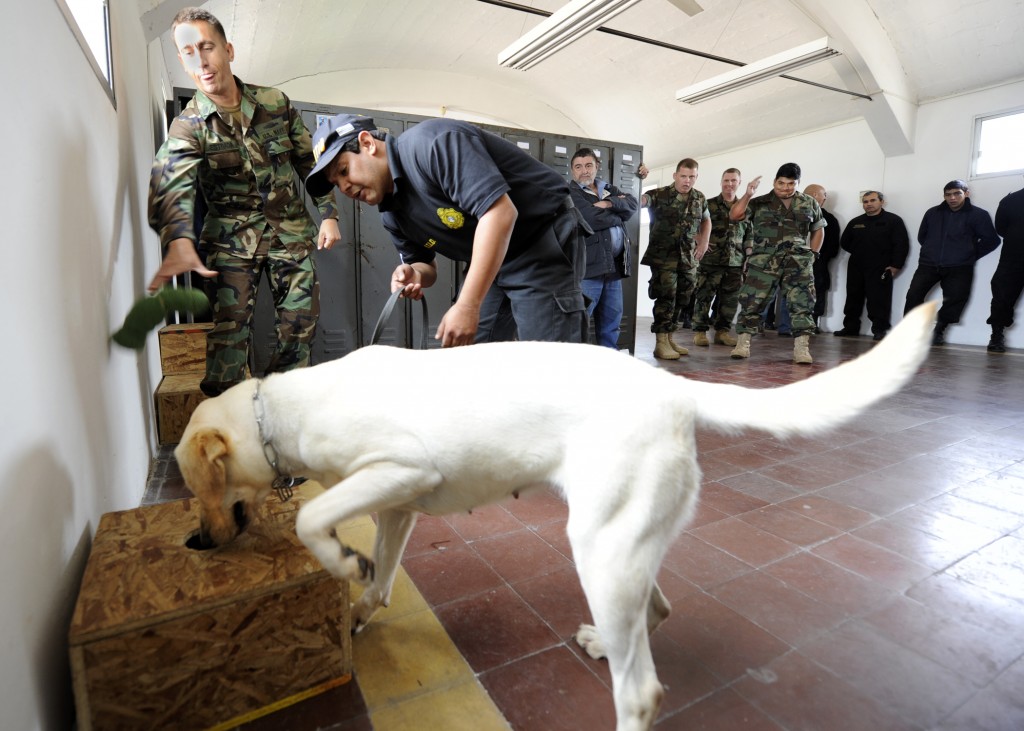
Nick Estrada of the U.S. Navy trains a drug-sniffing dog


UC Davis researchers hypothesized that the dogs were taking cues from their handlers. If that is true, the dogs are merely relaying the preconceptions of their handlers, and it calls into question the validity of drug-sniffing dogs in any circumstance.

The Supreme Court might not speak on the validity of drug-sniffing dogs when it rules on this case, but it should. It is important that police have actual evidence when they request that a search warrant from a judge; the preconceptions of dog handlers should not be enough for probable cause.


Leave a comment

Hard Science Versus Forensics, Part 5: Ballistics

Part 1: Introduction
Part 2: Fingerprints
Part 3: Bite Mark Analysis
Part 4: Arson

Photo courtesy of Niels Noordhoek

Ballistics (sometimes called “ballistic fingerprinting”) examines the markings that firearms leave on bullets to match a bullet to the firearm that fired it. Likening it to fingerprinting is an apt analogy. Like fingerprinting, ballistics suffers from a lack of independent verification of its assumptions.

Most firearms impart spin on a fired bullet, and subtle variations in the spirals within a firearm barrel leave tiny grooves called “striations” on the bullet. The striations a particular firearm imparts are supposedly unique. A technician attempts to match a bullet of unknown origin with the barrel through which the bullet was fired. However, it has not yet been proven that the striations are unique, but we know that striations are inconsistent. Different makers of bullets have different striations, even when they go through the same barrel. Wear and tear from regular use and intentional damage to the inside of the firearm barrel can also change striations.

Like fingerprinting, ballistics has to deal with the difference between lab conditions and real world conditions. Bullets fired in a laboratory are fired into a soft medium to keep the bullet intact, but bullets found at crime scenes are often damaged from smashing into hard materials. Ballistics labs do not have definitive guidelines for how much damage to a bullet is too much.

One expert may disagree with another about whether two bullets were fired from the same firearm. It is up to individual technicians to decide whether they feel comfortable that the striations on a bullet from a crime scene sufficiently match the striations from the suspected weapon. Ultimately, a human makes a judgment call, and no agency is conducting quality control to ensure the accuracy of a technician’s determination.