Natty Shafer Law

Utah lawyer for criminal and immigration cases


Leave a comment

K-1 Visas for Fiancé(e)s

These days, it has become more common for two people from different countries to meet and become engaged. With the internet, messageboards, dating services, or travel, two people from different parts of the world can form lasting relationships and even marry. If one of the people is a United States citizen, the K-1 visa is likely to be of interest.

A K-1 or fiancé visa is a nonimmigrant visa that allows a fiancé or fiancée of a United States citizen to enter the country. A K-1 visa requires an immigrant to marry his or her U.S. citizen petitioner within 90 days of entry. After the marriage, the foreign citizen can adjust their status to become a lawful permanent resident. If a K-1 visa holder does not marry the petitioner within 90 days of entry, the immigrant must depart the United States. Unfortunately, such immigrants cannot adjust their status using other criteria and must depart the United States before reentering.

The majority of K-1 visas are granted, which makes the K-1 visa a good option for immigrants who meets the criteria. The U.S. citizen petitioner must file the I-129F form for the immigrant. Upon the immigrant’s entry into the United States, the couple has 90 days to marry and file an adjustment of status. Once the I-129F is issued, you have four months to make all travel arrangements and make the entry into the United States.

Both the petitioner and the fiancé(e) must be eligible to be lawfully married in the state of residence of the petitioner, which means that everyone must be either unmarried or have had their marriages legally ended through divorce, annulment, or death. Also, the couple must have met in person at least once during the two years before filing the petition (unless there is a strong religious or cultural reason, which might allow for a waiver). Finally, the petitioner must be able to prove they can financially support their future spouse.

1 Comment

Supreme Court to Hear Challenge on Drug Dogs

This fall, the Supreme Court of the United States will hear oral arguments in a case that challenges the use of drug-sniffing dogs to perform warrantless searches outside a suspect’s house. The case, Florida v. Jardines, arose when Miami police received a tip that Joelis Jardines was growing marijuana in his home. The police took a drug-sniffing dog around the perimeter of his house, and the dog indicated that it smelled drugs. Based on that information, the police obtained a search warrant of the house, and they found marijuana plants growing inside.

The Supreme Court has previously allowed drug-sniffing dogs to be used around cars or in the airport, but since that time a study from UC Davis has called into question the validity of drug-sniffing dogs. UC Davis recruited 18 law enforcement dogs with their human handlers for the study. Experimenters told the handlers that drugs or explosives might be present at the testing site, but neither one was present in any of the rooms. If the dogs had behaved appropriately, they would have passed through all four rooms without alerting their handlers. Only one of the 18 dogs did not falsely alert in any of the rooms.

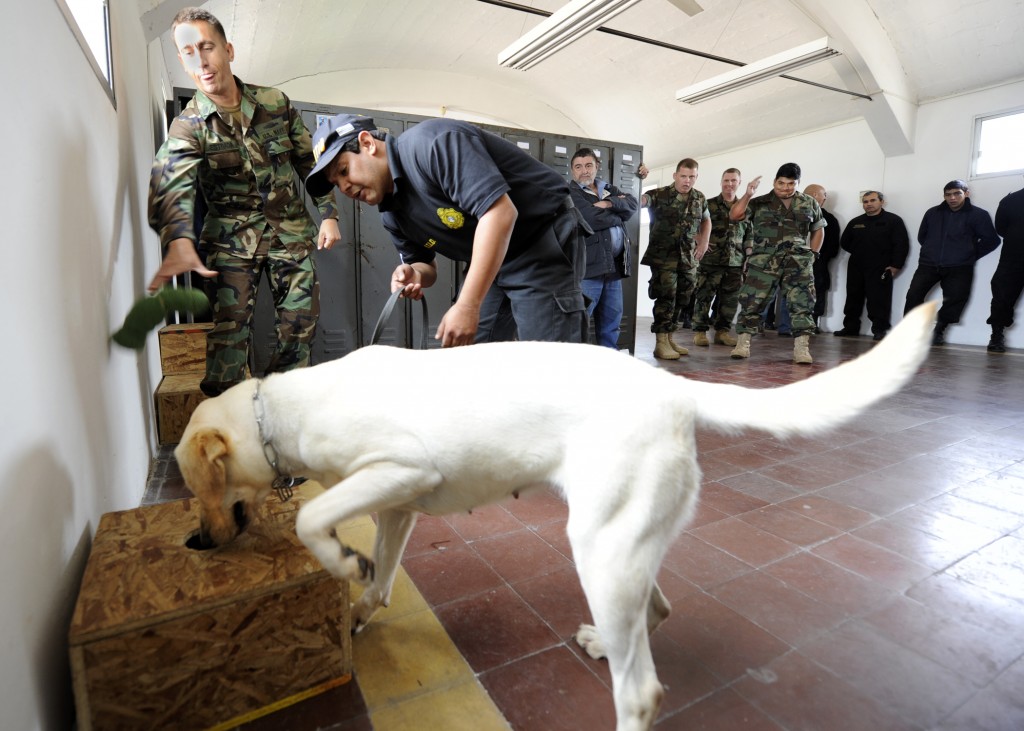
Nick Estrada of the U.S. Navy trains a drug-sniffing dog


UC Davis researchers hypothesized that the dogs were taking cues from their handlers. If that is true, the dogs are merely relaying the preconceptions of their handlers, and it calls into question the validity of drug-sniffing dogs in any circumstance.

The Supreme Court might not speak on the validity of drug-sniffing dogs when it rules on this case, but it should. It is important that police have actual evidence when they request that a search warrant from a judge; the preconceptions of dog handlers should not be enough for probable cause.


Leave a comment

Hard Science Versus Forensics, Part 5: Ballistics

Part 1: Introduction
Part 2: Fingerprints
Part 3: Bite Mark Analysis
Part 4: Arson

Photo courtesy of Niels Noordhoek

Ballistics (sometimes called “ballistic fingerprinting”) examines the markings that firearms leave on bullets to match a bullet to the firearm that fired it. Likening it to fingerprinting is an apt analogy. Like fingerprinting, ballistics suffers from a lack of independent verification of its assumptions.

Most firearms impart spin on a fired bullet, and subtle variations in the spirals within a firearm barrel leave tiny grooves called “striations” on the bullet. The striations a particular firearm imparts are supposedly unique. A technician attempts to match a bullet of unknown origin with the barrel through which the bullet was fired. However, it has not yet been proven that the striations are unique, but we know that striations are inconsistent. Different makers of bullets have different striations, even when they go through the same barrel. Wear and tear from regular use and intentional damage to the inside of the firearm barrel can also change striations.

Like fingerprinting, ballistics has to deal with the difference between lab conditions and real world conditions. Bullets fired in a laboratory are fired into a soft medium to keep the bullet intact, but bullets found at crime scenes are often damaged from smashing into hard materials. Ballistics labs do not have definitive guidelines for how much damage to a bullet is too much.

One expert may disagree with another about whether two bullets were fired from the same firearm. It is up to individual technicians to decide whether they feel comfortable that the striations on a bullet from a crime scene sufficiently match the striations from the suspected weapon. Ultimately, a human makes a judgment call, and no agency is conducting quality control to ensure the accuracy of a technician’s determination.


Leave a comment

U Visas

The U Visa (officially “U nonimmigrant status”) is a humanitarian program intended for crime victims. It allows victims to work and stay legally in the United State for four years, with the possibility of renewal. After three years, a U Visa holder may apply for a permanent resident card (green card) if they have lived continuously in the U.S. for that period, and they cooperated with law enforcement with the the prosecution of their case or any other investigations. Unlike some other visa applications, there is no filing fee for the U Visa, and undocumented immigrants are eligible to apply.

Not all crime victims are eligible, but many are, depending on the severity of the crime and where it occurred. The law requires that the victim suffered substantial mental or physical abuse as a result of the crime, and it has to have violated U.S. law, which generally requires that it occurred in the U.S. Victims of domestic abuse are one of the more frequent applicants, but many other crimes qualify too, such as assault, rape, or involuntary servitude.

Law limits the number of U Visas to 10,000 each fiscal year, which ends the last day of September. That limit has not yet been reached this year, but if last year is any indication, it will be reached a few weeks before the fiscal year ends.

Family members who accompany the U Visa applicant may be eligible for a U Derivative Visa. The U Visa “principal” must petition on behalf of qualifying family members. If a U Visa applicant is under the age of 21, the applicant’s spouse, children, parents and unmarried brothers and sisters under the age of 18 may apply. If the U Visa applicant is over the age of 21, only the applicant’s spouse and children may apply.

If you think you or a family member qualify for a U Visa, see an immigration lawyer to help you with the application. In Utah, many undocumented immigrants are afraid to go to the police when they have been victimized, but going to the police is necessary to getting a U Visa and legally remaining in the United States.


1 Comment

Hard Science Versus Forensics, Part 4: Arson

Read previous posts about dubious areas of forensic science by following these links:

Part 1: Introduction
Part 2: Fingerprints
Part 3: Bite Mark Analysis

Training exercise burning

Photo courtesy of 111 Emergency


Arson investigation, unfortunately, is a field where junk science has been the rule rather than the exception. Rarely are houses intentionally set on fire to allow investigators to study the unique effects of burning houses. There are subtle yet distinct differences in how houses burn in comparison to other fires. Many arson investigators rely on their intuition and have been slow to adapt to studies that show that their assumptions are bogus.

For example, it used to be that arson investigators interpreted signs that a fire burned particularly hot as proof that an accelerant, such as lighter fluid, was used. Experiments have shown that wood and gasoline fires burn at nearly identical temperatures. A natural wood fire can reach temperatures in excess of 2,000 degrees, hot enough to melt or burn many household objects. Melted copper wiring, melted steel bedsprings, and “crazed glass” all were used as evidence of arson. But crazed glass is usually the result of rapid cooling—such as when firefighters put out a blaze—and the upper ranges of pure wood fires are enough to melt copper and steel.

Another common misconception is that floors won’t burn unless an accelerant has been used. One experiment was all it took to disprove that theory. Investigators in Duval County, Florida were trying to prove that a fire could not have happened the way a defendant claimed it did. In the process, they proved his case. They spent $20,000 to hire experts and equip a condemned house with heat and gas sensors. They lit a couch on fire, without using any accelerants, and watched what happened. The fire quickly consumed the couch and filled the room with smoke. Just four and a half minutes later the room suddenly burst into flames, including the floors, walls, and furniture. The prosecutor quickly dropped the case against the defendant.

The experimental house burned so rapidly because of “flashover.” Flashover occurs when smoke and gas in a room build, to the point where it finally explodes in flames, including the floor. The house reached over 1,000 degrees just before flashover. Before this experiment, investigators were aware of flashover, but most believed it took longer to occur, especially without a liquid accelerant. It is impossible to say how much more the field of arson investigation would advance with a few more experiments.

It is still remarkably easy to be certified as an arson investigator in many states. Some states require as little as 40 hours of training before someone can be deemed an expert in arson investigation. All over the country, there are poorly trained investigators that are still using techniques that have no basis in science.


Leave a comment

Curious Development in the Obamacare Case

Excuse me for a moment while I have a nerdgasm, but this stuff does not happen often. Yesterday, Jan Crawford of CBS News got a major scoop detailing some of the inner-workings of the Supreme Court during the Obamacare case. Apparently, Chief Justice Roberts originally sided with the four other conservative justices to declare the individual mandate unconstitutional, but he changed his mind. The conservative justices then spent a month trying to get him to change his mind back.

The Supreme Court usually doesn’t leak this kind of story. The Court eschews most publicity—cameras aren’t even allowed in the courtroom—and details about the Courts’ deliberations usually come out years or decades later, if they come out at all. For this story to come out just three days after the decision means that a justice or a clerk wanted this story released immediately. It could have been anyone, but it most likely that someone angry leaked the story. It is unlikely that a clerk would risk their career without having permission to talk. One or more of the conservative justices, directly or indirectly, likely leaked this story.

If true, it explains several oddities about the case. For one, it would explain why none of the conservative justices were willing to join any portion of Roberts’ opinion, even the parts they agreed with, and it explains why the dissenters refused to reference his opinion in their unsigned joint opinion. But most of all is explains the sudden appearance around Memorial Day of op-ed pieces accusing the “liberal media” of trying to bully Roberts into changing his vote. (Linda Greenhouse, legal blogger for The New York Times, noticed this too.) It caught my attention at the time, because the op-ed pieces specifically singled out Roberts as the target of an alleged liberal campaign, instead of Justice Kennedy, who is generally more likely to vote with the liberals on the Court.